Over the past year, Russia’s war against Ukraine has been marked by an unprecedented surge in UAV use. Drones have become a key element of reconnaissance, fire correction, and target destruction. Drones are so numerous that air defense systems are running out of ammunition to shoot them down. Additionally, as the range of FPV drones has grown, frontline air defense systems have themselves become vulnerable, and reconnaissance UAVs continue to fly unimpeded into the rear at altitudes of several kilometers. However, Ukrainian — and later Russian — forces have learned how to intercept drones en masse using a different type of drone: the anti-aircraft kind. Combined with other elements of layered air defense, these are capable of neutralizing threats that traditional air defense weapons are worst-equipped to cope with. Ukrainian interceptor drones, often operated from hundreds of kilometers away, are already shooting down as many as 45% of targets. This technological know-how may prove useful in other conflicts, including in the Middle East.
An air defense revolution: cheap and effective anti-aircraft drones
Shaheds have been one of Ukraine's main problems from the moment of their emergence on the battlefield in the fall of 2022. Together with the lighter Gerbera drones, which often act as decoys or scouts, they have become the primary means of Russian attacks on Ukrainian infrastructure, especially the country’s power grid. From February through April 2026, Russia was launching more than 200 Shahed-type drones into Ukrainian territory each day. For a long time, the Defense Forces of Ukraine (DFU) struggled to find countermeasures until cost-efficient interceptor drones came along.
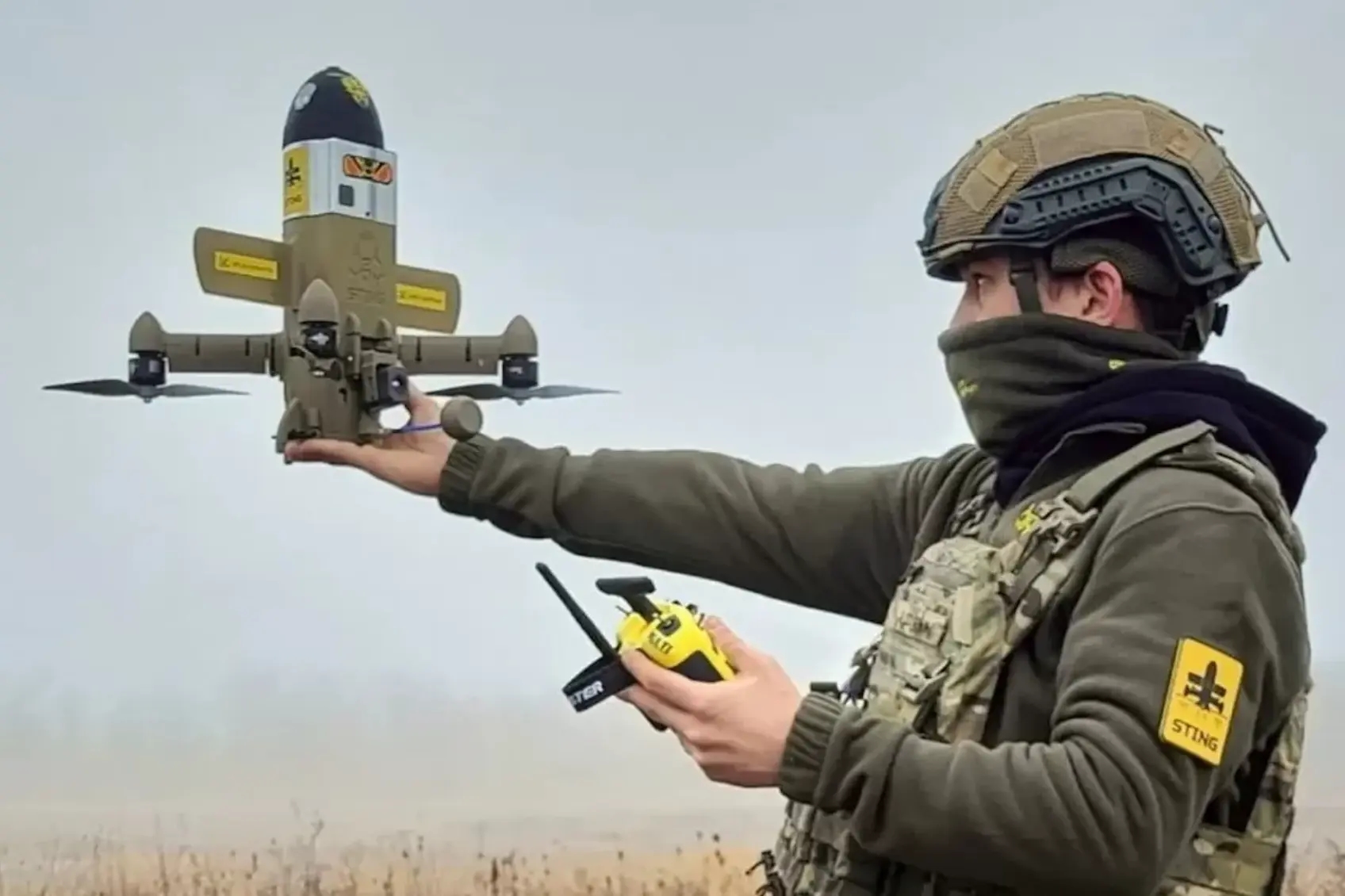
The use of anti-aircraft drones has been a known practice since mid-2024, when the DFU began using modified FPV drones to intercept Russian reconnaissance UAVs, such as the Orlan-10, Zala, and Supercam. Over time, the DFU acquired special-purpose models, such as Sting, Bagnet, and later STRILA, designed first and foremost to counter Shaheds.
Today, Ukrainian interceptor drones can hit Russian UAVs at ranges of up to 30 km beyond the line of contact, comparable to the range of a short-range surface-to-air missile (SAM) system.
Air defense based on anti-aircraft drones has proved to be cheaper and more mobile than the conventional kind. Intercepting a single Shahed requires up to two interceptor drones that cost around $3000 each. Meanwhile, the cheapest single shot from a SAM system (such as the Vampire) costs approximately $30,000.
Interception with air defense drones follows a simple pattern. A signals-intelligence post detects an enemy UAV heading toward the position. Compact radars then determine its range, altitude, and speed in order to give the operator of an air defense FPV a rough understanding of where the target is. Then, as soon as the enemy drone appears in the FPV-goggles or on the screen, the operator locks it in his sights and brings his own drone into close range. Several hundred meters from the target, an aim-hold system may engage automatically, but at the final stage, the operator remains free to choose between a direct ramming, a net drop, or an airburst of the charge.
The new technology has been a game-changer at the front, notes aviation expert Valeriy Romanenko. In March 2025, Ukrainian air defense drones (mostly based on primitive quadcopters) shot down a mere 2,518 Russian reconnaissance UAVs, including one Shahed. However, after a year of tactical development, in March 2026 Ukrainian air defense drones destroyed more than 33,000 Russian UAVs of various types, doubling the February figures.
In March 2026 Ukrainian air defense drones destroyed more than 33,000 Russian UAVs
The Russian side has begun to make more active use of jet Shaheds (Geran-3), whose serial production began in 2025. Still, despite their ability to reach speeds of 400 km/h, these soon proved vulnerable to Ukrainian interceptor drones as well. Footage of the interception of Geran-3s by air defense drones in tail-chase pursuit shows that the interceptors can outfly even a jet drone.
In April 2026 Russian Telegram channels showed the use of a jet “drone-missile,” the Geran-5, against oil and gas infrastructure in Sumy Oblast. Ukrainian UAVs cannot yet catch this drone, which can reach speeds of up to 600 km/h. The shape of the new Geran resembles a small cruise missile rather than a drone, and it is fitted with a more powerful jet engine than other types. Russian sources also demonstrated the use of the Geran-4, also jet-powered, against the energy infrastructure of Chernihiv Oblast. On May 3, however, an example of this modification being intercepted was recorded.
As Ukraine’s Defense Minister Mykhailo Fedorov stressed, “jet Shaheds” have become “a key challenge,” and Ukraine is developing new technological solutions to counter them. In particular, the minister promised support for the development of high-speed interceptors capable of reaching at least 450 km/h.
Russian interceptor drones
Interception assets in the FPV segment fall into two broad types: rotor-wing and fixed-wing. Each type is suited to a specific task. With a short range of up to 20–30 kilometers, copters are used mainly against slow-moving drones.
The air defense drones Boomerang-8 and Boomerang-10 are highly maneuverable, AI-enhanced suicide drones with automatic target hold capabilities and a speed of up to 170 km/h. They are used for both interception and reconnaissance. Among the advantages of the air defense variant of the Boomerang FPV drone, Russian pro-war authors note a wide range of frequency combinations, a convenient and clear software platform, easy setup, and adequate technical support. Drawbacks include weak batteries and a stand that is not fully adapted to the tasks of air defense crews. The Boomerangs are used to intercept relatively low-speed reconnaissance drones and fixed-wing suicide drones, such as the Darts, and Baba-Yaga hexacopters.
Fixed-wing drones are used to intercept larger and faster UAVs such as the FP-1, the FP-2, or the Liutyi. As the author of the Russian Telegram channel ARKHANGEL SPETSNAZA writes, this category is largely represented in the Russian Armed Forces by the interceptor drones Sokol, Molniya-PVO, and, more recently, Lis.
The Sokol-1 and Sokol-2 interceptors possess high-quality digital video links, an airburst capability, high speed, and good maneuverability — but the use of standard control frequencies negates all these advantages.
The Molniya-PVO, a modification of the Russian FPV suicide drone of the fixed-wing Molniya family, is designed to intercept and destroy heavy drones like the Baba-Yaga. The drone can be launched by hand, reach speeds of up to 220 km/h, and is equipped with both a digital video system and an analog video link featuring conventional and thermal-imaging cameras. Notably, the digital system is usable only in daylight and at short range. The drone has a proximity sensor, which detonates the warhead when a target appears at a set distance from the bow camera. Among the Molniya-PVO's drawbacks are a weak battery and the lack of a thermal-imaging digital version for nighttime work or a standard ground control station. Users have also complained of poor technical support along with the manufacturer’s reluctance to respond to feedback.
Interceptor drones Lis and Lis-2, from the makers of the Boomerang, exist in daytime and thermal-imaging versions. Both feature the target-lock function, which noticeably eases the operator's work. However, their time in the air is limited due to a weak battery, meaning their key user scenario involves high-speed interception rather than long patrols.
The Yolka (“Fir Tree”) drone combines the characteristics of fixed-wing drones and quadcopters. It can hit a wide range of targets, from small FPV-drones and reconnaissance craft to heavy UAVs. The compact drone features a target lock-on and has an engagement range of up to 3 km while flying at speeds of up to 200 km/h. Notably, this model has no warhead and engages the target kinetically, which reduces its effectiveness while increasing its popularity in the Russian Armed Forces: after all, Russian personnel are banned from using improvised explosive devices.
Last May, it was stated that the Yolka possesses an AI-enhanced target-lock and tracking system (in effect, an electro-optical homing head). At the same time, analysts noted a significant drawback (1, 2): the target auto-lock fails in low-light conditions. These interceptors have been on the battlefield since September 2024 and are being actively used (1, 2) by mobile firing groups, air observation posts, and frontline units. In February 2026, reports emerged of mass deliveries of Yolka drones to Russian Armed Forces units.
Ukrainian interceptor drones
The Defense Forces of Ukraine have several types of interceptor drones in their arsenal. The best known is the P1-SUN, made by the Ukrainian company SkyFall. This UAV, unveiled in the fall of 2025, can accelerate to 300 km/h and climb to altitudes of up to 5 kilometers. The airframe is made using 3D-printing, which keeps its cost in the vicinity of $1,000. The warhead contains up to 800 grams of explosives — enough to shoot down a Shahed. P1-SUN destroys the target by ramming it or by detonating next to it. According to information from Ukrainian Defense Ministry adviser Anna Hvozdyar, as of late April P1-Sun drones had intercepted more than 3,000 Russian Shaheds.
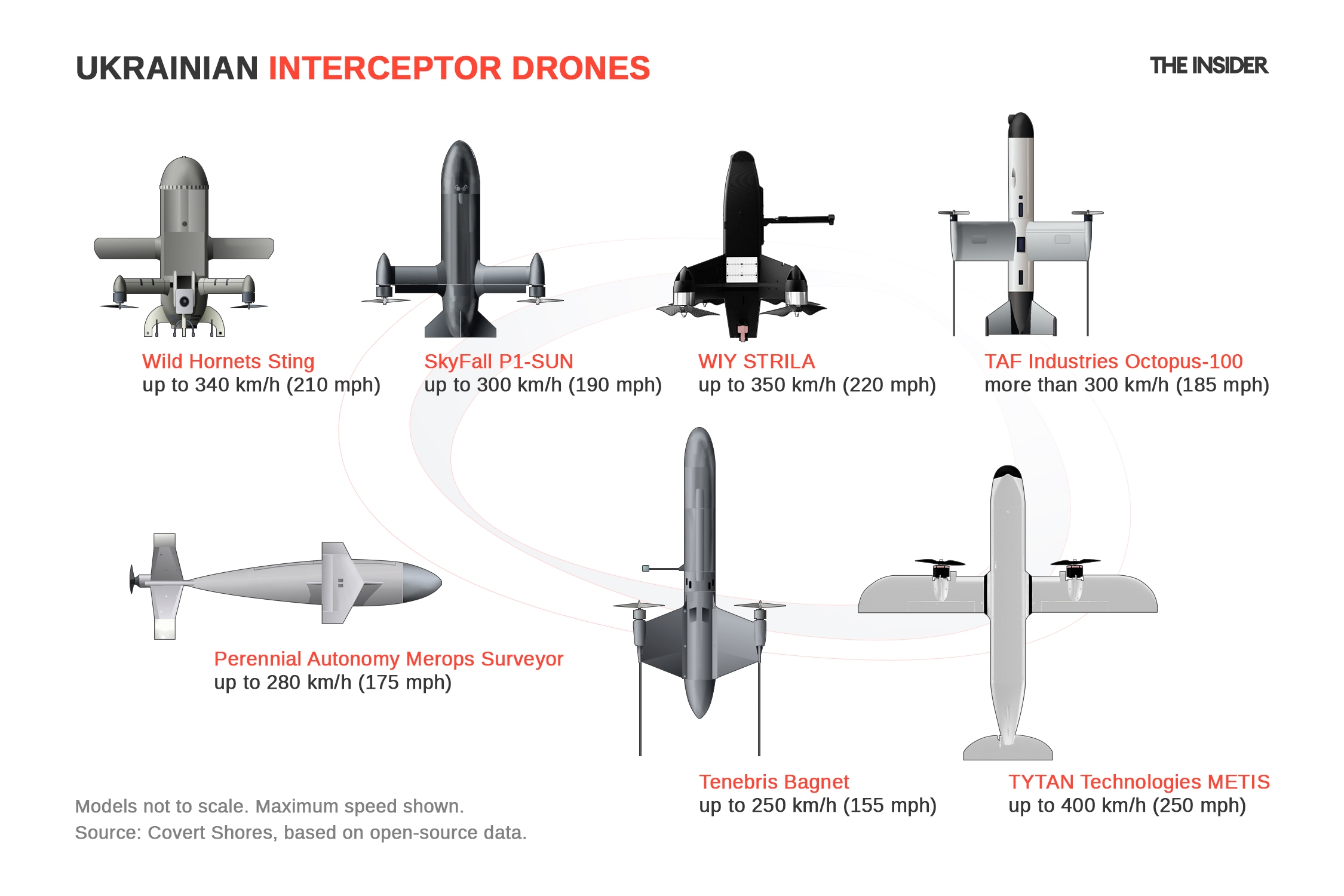
The Ukrainian Sting interceptor drone, serially produced by the Wild Hornets non-profit, was designed to intercept Shaheds and has since been enhanced to counter nighttime attacks on Ukrainian cities and infrastructure objects. It has also been spotted intercepting a jet-powered Shahed while fitted with an R-60 air-to-air missile. The Sting can reach speeds of more than 340 km/h and operates at altitudes of up to 3 kilometers.
The Osminog (“Octopus”) air defense drone is a joint Ukrainian-British development created to counter Shahed-type UAVs. The drone can reach speeds in excess of 300 km/h. It is equipped with an AI-based control system for automatic terminal guidance to the target, can operate around the clock, is resistant to EW systems, and performs well at low altitudes. More than 29 private Ukrainian companies have received licenses for its serial production, and assembly in the United Kingdom is also planned. Four Ukrainian manufacturers have signed contracts to deliver 8,000 drones to the DFU, the Defense Ministry reported on April 30.
The Merops system, developed by the American defense company Perennial Autonomy, was supplied to Ukraine in 2024 and has shown high effectiveness, according to U.S. Army Secretary Daniel Driscoll. The Merops consists of a ground control station, which detects the target, launchers, and Surveyor reusable interceptor drones with a compact warhead. The interceptors are fitted with wings, typical of fixed-wing UAVs, and X-tail stabilizers. The exact technical specifications of the system are not disclosed, but the Surveyor is known to reach speeds exceeding 280 km/h. A distinctive feature of the system is its ability to work both autonomously and under an operator's remote control. Merops can function in EW conditions and uses AI for autonomous navigation when GPS and comms are jammed. The cost of a single Merops system is $14,000–15,000, but the unit price can drop significantly for large orders. It is currently known to be in use in the Middle East.
The Bagnet air defense drone, made by the Ukrainian defense company Tenebris, is 85% composed of domestically produced components. It is designed for the detection, interception, and destruction of loitering munitions at altitudes of up to 5 kilometers. Bagnet reaches speeds of up to 250 km/h and is fitted with a warhead of up to 1 kilogram. It uses an explosively-formed penetrator to destroy targets in the air and reduce the risk of falling debris. Its built-in guidance system, developed by the French startup Alta Ares, can detect the target and steer the drone toward it in the final stage of the flight. Another important feature is automatic takeoff and return in the event no target is detected.
German TYTAN Technologies interceptor drones emerged at the end of 2024 and were immediately put to the test in real combat conditions in Ukraine. These autonomous air defense drones detect, track, and destroy Shaheds and reconnaissance UAVs by direct hit — all with minimal operator involvement. This past April, TYTAN Technologies announced a special shipment of more than 1,000 METIS interceptor drones for Ukraine's National Guard. The new AI-enhanced version has a range of more than 45 kilometers, reaches speeds of up to 400 km/h, and is capable of effectively engaging targets at altitudes of up to 6 kilometers while carrying a warhead of up to 1 kilogram.
STRILA is a Ukrainian air defense missile-type UAV produced by WIY Drones. It is designed to intercept high-speed and maneuvering airborne targets. STRILA uses original WIY software and target-designation sources that allow the operator to receive data on the target's direction, altitude, and speed. The drone has an operating radius of up to 14 kilometers and a range of 28 kilometers. It operates at altitudes of up to 5 km, carries a warhead of up to 800 grams, and reaches speeds of up to 350 km/h.
This past March it was announced that Ukraine’s WIY Drones and Germany’s Quantum Systems had released the STRILA-2 modification featuring a solid-fuel rocket booster that allows the UAV to take off almost vertically and gain altitude in a matter of seconds before switching to energy-efficient flight using four electric motors. As a result, the STRILA-2 can attack targets from above, while built-in AI-driven software helps it autonomously recognize and lock onto the target even when comms are jammed by EW tools. The German government has financed an order to produce 15,000 STRILA interceptors for Ukraine's National Guard. The cooperation envisions not only procurement but also the expansion of production to Ukraine itself.
In short, air defense is undergoing substantial changes due to Russia’s ongoing war against Ukraine. Given the shortage of SAMs in the world and the growing prevalence of cheap one-way attack systems, the emphasis is shifting toward creating affordable air defense alternatives such as interceptor drones.
The more Russia launches, the more Ukraine shoots down
In February 2026, Ukrainian Defense Minister Fedorov named the protection of the country’s civilian population and critical infrastructure as his ministry’s top priorities, setting the goal of detecting 100% of airborne threats in real time and intercepting at least 95% of missiles and drones. To that end, the minister ordered the creation of a multi-layered air defense system and a ramp-up in interceptor production. As early as April 1, Ukraine’s Defense Ministry stated that in March, Ukraine’s air defense systems had destroyed or suppressed 89.9% of Russian airborne targets, compared with 85.6% in February and 80.2% in December.
The growing effectiveness of countering Shahed-type strike UAVs and their decoys has been driven at least in part by the DFU’s increased use of air defense drones, which shoot down about 45% of targets. As Fedorov reported April 28, over the first four months of 2026 the DFU had received twice as many interceptor drones as it did in all of 2025.
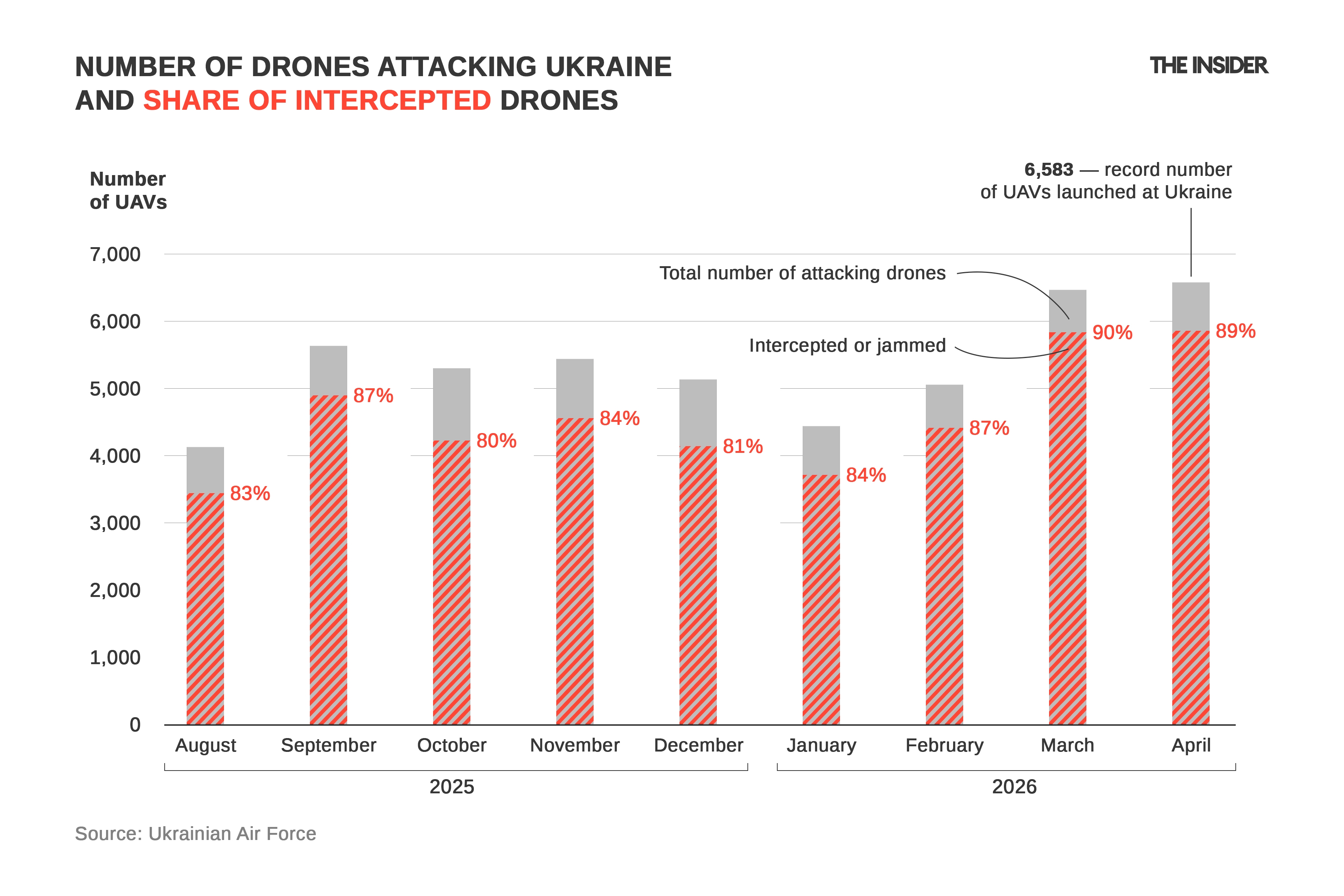
Interception effectiveness is growing in step with a rising number of Russian launches. In effect, the two sides are now locked in an unmanned technology race: Ukraine’s main objective is to increase kill effectiveness while producing large numbers of interceptors at low cost, while Russia is focused on producing more strike drones and adapting them to Ukraine’s new countermeasures. To accomplish this task, Ukraine must stay at least ten steps ahead of the enemy in every technological cycle and keep its lead in the war of innovation, Fedorov believes.
Both sides are now locked in an unmanned technology race
This past April, the defense minister said that Ukraine has developed interceptor drones that can be controlled remotely to engage targets hundreds — or even thousands — of kilometers away. Coupled with the Sting drone, the HORNET VISION Ctrl system forms a new air defense architecture in which mobile interceptors can effectively repel large-scale attacks of suicide drones while they are still over enemy territory. On April 4, Roman ‘Hulk’ of the BULAVA unit reportedly destroyed two Shaheds from a distance of 500 kilometers using this technology. According to Fedorov, more than a dozen manufacturers have already integrated this innovation into their systems.
In addition, the Defense Forces of Ukraine have begun using air defense drones deployed on the Magura V5 sea drone. As The Economist reported in early March, this technology was developed in response to the Russian tactic of launching drones over the sea in order to make them harder for Ukrainian EW to detect.
The first Ukrainian tests took place in the Black Sea near Odesa. According to the description of the technology, the Ukrainian unmanned vessels operate in groups, forming a common radar field. When a target is detected, an interceptor drone is launched from a special hatch on the deck of the boat and is then remotely controlled via Starlink. In mid-April, the surface unmanned systems division of the 412th Nemesis Brigade of Ukraine’s Unmanned Systems Forces reported the first successful destruction of a Shahed using an interceptor drone launched from an unmanned surface vehicle.
Another unconventional solution has involved launching interceptors from an aircraft. Ukrainian aviator Tymur Fatkullin posted a video on April 23 showing launches of P1-SUN air defense drones suspended under the wings of a PZL M28 Skytruck light transport aircraft (the Polish modification of the An-28).
Originally, in order to intercept Shaheds the aircraft was fitted with an M134D machine gun by Dillon Aero. To hit the target, it has to fly in close, and as a result, on one of the sorties debris from a downed Shahed damaged the wing of the An-28. After this incident, the method of launching P1-SUN interceptor drones from the aircraft was tested. As a result, the aircraft acts as a delivery platform for drones — a setup that significantly expands the interceptors' range.
Ukraine’s air defense landscape notably features a number of private actors. As Mykhailo Fedorov reported on March 30, one such group created by a company in Kharkiv Region has already shot down several Shaheds and Zalas. On April 17, Fedorov noted that the same air defense group had destroyed a jet-powered Shahed flying at a speed of more than 400 km/h.
As of April 30, the private air defense project has been joined by 24 entities from all across Ukraine. The experimental framework that allows private enterprises to set up their own air defense units was approved by Ukraine's Cabinet of Ministers in November 2025, and at the beginning of March 2026 the government permitted critical-infrastructure enterprises to receive additional weaponry to strengthen their air defense capabilities. The arsenal of such groups includes air defense drones and remotely operated machine guns.
Private air defense systems ensure coverage for vulnerable areas, protecting commercial and infrastructure facilities. Ukraine is effectively becoming the first country to consistently integrate private companies into its air defense network.
Prospects for the development of air defense drones
Former Ukrainian prime minister and current chair of the expert council of the Nemesis brigade Oleksiy Honcharuk has observed the exponential growth in his country’s drone capabilities. “Every year, a drone either halves in size or price, or doubles its range,” he says.
Still, Russia continues to make modifications of its own. Shaheds may soon become not weapons but delivery vehicles carrying smaller drones. The Russian Armed Forces already use Shaheds to launch FPV-drones near the front line, and this practice will likely ultimately require Ukraine to devise a new means of defense: walls of interceptor drones, automatically launched on detection, without operator involvement. “It may sound like science fiction, but we are already preparing for it,” Honcharuk insisted.
In April 2026, former CIA director General David Petraeus returned from a trip to Ukraine, where he had spent time in a specialized drone unit in Zaporizhzhia. Petraeus sees promise in the emergence of drone swarms — truly autonomous formations that do not require operators for remote control and are virtually impossible to intercept or suppress due to their huge numbers. He believes that in response to this threat, breakthrough technologies will appear, possibly including powerful microwave systems.
Petraeus sees promise in the emergence of drone swarms, which do not require operators and will be virtually impossible to intercept using current defenses
Several companies are already working on a project to deploy interceptor swarms within the Brave1 cluster. The developers aim to get the drones working as a single system controlled by one operator in real time.
In the near future, AI capabilities will likely enable air defense drones to change course on their own in order to dodge obstacles, respond to changing conditions, and safely and effectively carry out missions. In particular, the Hornet interceptor drones by Destinus have received a combat AI system from the U.S.-based defense technology company Shield AI. During trials in Spain in early 2026, the Hornet drones with Shield AI’s Hivemind system independently corrected their flight trajectory in real time, adapting to changing conditions and tasks. Both Destinus and Shield AI are already working with Ukraine.
Ukrainian air defense drones and the Middle East conflict
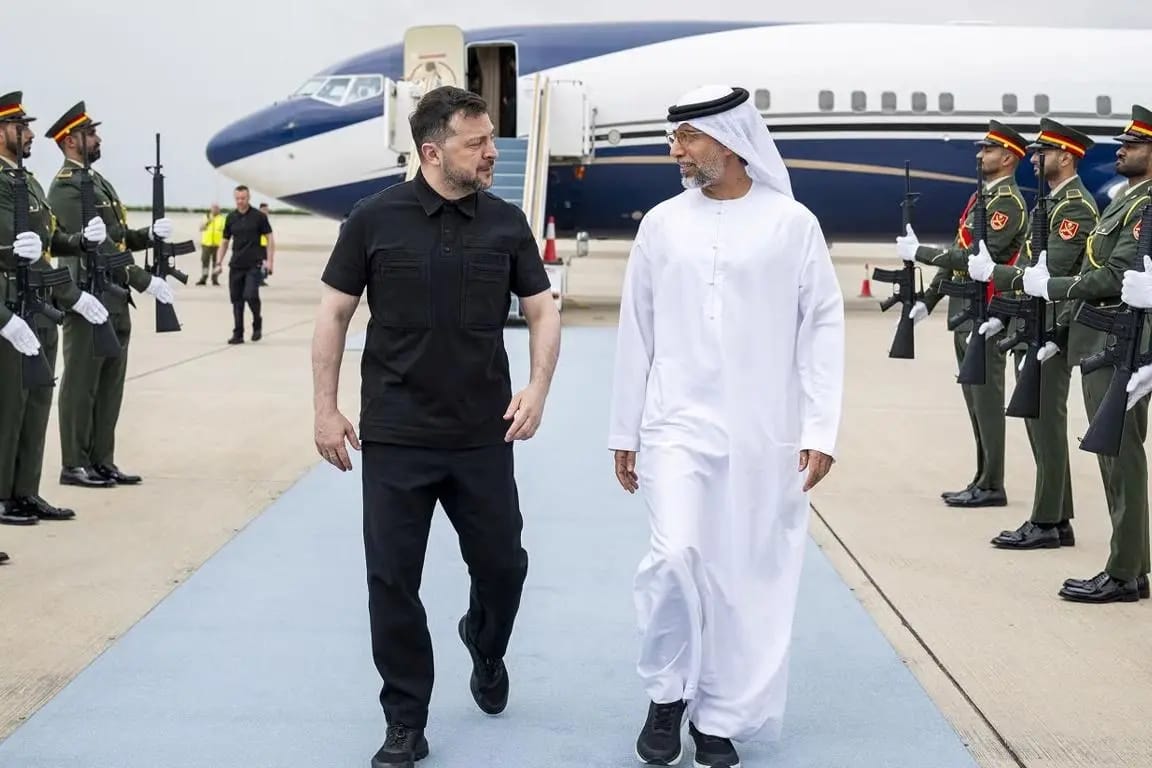
After President Zelensky’s March 2026 visit to the Persian Gulf, which resulted in the signing of defense agreements with a number of countries in the region, Ukrainian UAV manufacturers have entered the spotlight as potential leaders of arms exports to the Middle East, writes The Times. However, in practice, they have run into difficulties with export licensing and have been drawn into a debate over the utility of selling interception systems abroad at a time when Ukraine itself has to repel regular attacks.
Even among drone manufacturers, there is no consensus. “If your house is on fire, you don't sell water to a neighbor,” a senior Wild Hornets representative said in a comment to The Times, and Kyrylo Budanov joined the debate by taking the position that the free sale of weapons during an active phase of war is unacceptable. Still, others believe that UAV exports will stimulate growth in domestic production by allowing companies to raise capital via sales to the Persian Gulf.
The situation is further complicated by the military dimension: Russian cruise and ballistic missiles remain out of reach for Ukrainian air defense drones, and although Moscow’s missiles are vulnerable to Western-made PAC-3 SAMs, these are in short supply in Ukraine. At a March 30 press conference, Zelensky cited a global shortage of anti-ballistic missiles, noting that only about 60 PAC-3 interceptor missiles for the Patriot SAM system are produced per month — and that most of the production output is currently being sent to the Middle East.
In January 2026, Zelensky spoke of a critical shortage of SAMs: the shipment of PAC-3 was around a month late and arrived only a day after a large-scale Russian strike caused a near-total blackout in the country. According to Zelensky, the Ukrainian side had known in advance about the launch of ballistic missiles against power infrastructure and had deployed Patriot and NASAMS systems, but Kyiv’s forces could not use them due to the lack of ammunition. For this reason, Kyiv is considering an informal arrangement with the Persian Gulf states: trading Ukrainian technology in the field of unmanned systems in exchange for interceptor missiles.
On April 28, Zelensky announced several decisions aimed at simplifying the transfer of Ukrainian weapons and expertise abroad under existing partnerships. The very next day, TAF Industries, a private Ukrainian FPV drone manufacturer, reportedly received its first request for military consulting: to send specialists with anti-drone systems to protect a vessel in the Strait of Hormuz.
A CIT expert who chose to remain anonymous explained to The Insider that Ukrainian air defense experience and technology are applicable to the Gulf states’ predicament only in part. Simply scaling up the use of Ukrainian solutions is unlikely to produce a comparable result in the Middle East due to the fundamental differences in geography and the structure of threats. Ukraine is a large country, which gives its air defense network ample time to detect threats against regions that do not border Russia. However, in areas where the time of flight is minimal, interception has remained a serious problem even after the introduction of air defense drones.
Ukrainian air defense experience and technology apply to the Gulf states only in part
In the Gulf states, the situation is fundamentally different. Except for Saudi Arabia, most countries of the region are relatively small in size, and key infrastructure is concentrated along the coast. Therefore, their air defense systems essentially have no time buffer, as targets can reach their objectives in a matter of minutes. Accordingly, interception must take place either instantly over land, or — more logically — over the waters of the Gulf.
This is where a whole set of new questions arises. Ukrainian air defense relies on a network of acoustic sensors for threat detection and interceptor drones. But how does one deploy such infrastructure over water? To date, there is no practical solution to this problem, and the role of air defense drones in the maritime zone remains uncertain. For now, the leading role in intercepting targets over the Gulf belongs to conventional tools: aviation, including helicopters and aircraft that use inexpensive engagement munitions such as guided rockets of the APKWS class.
Military expert Kirill Mikhailov, however, draws attention to the fact that Iranian Shaheds that were fired at the Gulf states appear to have barely evolved since 2022, making them simpler targets than the Russian Gerans, which have acquired serious EW countermeasures and remote-control systems over the course of the war. In Mikhailov’s estimation, this means that the application of current Ukrainian technology and know-how could make a serious difference in the Middle East, at least until Iran improves its attack munitions.
In turn, the CIT expert notes that Ukraine leads the world in the development of air defense drones, primarily thanks to the scale of investment and their constant combat use, which provides continuous feedback. In the Ukrainian case, shortcomings are quickly identified and fixed, and solutions are rapidly refined. At the same time, the technologies themselves are not unique and their underlying principles are well explored, meaning other countries can close the gap fairly quickly if they make it a priority to do so. The main advantage in the area of drone warfare is not secret developments, but the accumulated experience necessary to constantly improve existing systems faster than the enemy can.